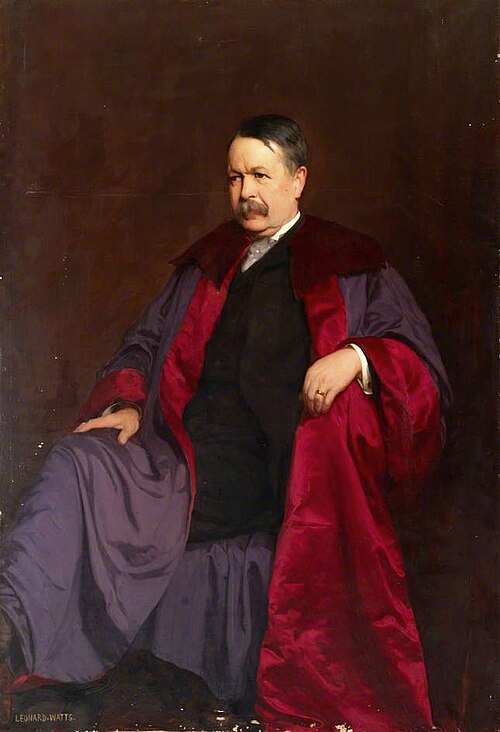
 James Stuart (January 2, 1843 – October 12, 1913) was a prominent British educator, politician, academic, and industrialist whose life spanned significant developments in
higher education reform, municipal politics, and journalism.
James Stuart (January 2, 1843 – October 12, 1913) was a prominent British educator, politician, academic, and industrialist whose life spanned significant developments in
higher education reform, municipal politics, and journalism.Queer Places:
University of Cambridge, 4 Mill Ln, Cambridge CB2 1RZ
Carrow Abbey, Bracondale, Norwich NR1 2DD, United Kingdom
Rosary Cemetery, Rosary Rd, Thorpe Hamlet, Norwich NR1 4DA, United Kingdom
James Stuart (January 2, 1843 – October 12, 1913) was a prominent British educator, politician, academic, and industrialist whose life spanned significant developments in
higher education reform, municipal politics, and journalism.
Born in Markinch, Fifeshire, he was the eldest son of Joseph Gordon Stuart, a textile industrialist who operated the Balgonie Works flax mill, and Catharine Booth, daughter of David Booth. His early education took place at Madras College in St Andrews before he entered the University of St Andrews, where he was awarded the Ferguson Scholarship in 1861. Continuing his academic career at Trinity College, Cambridge, from 1862, he excelled in mathematics and graduated in 1866 as third wrangler, subsequently being elected a Fellow of Trinity College in 1867 and receiving his Master of Arts in 1869. As an undergraduate, he actively participated in intellectual circles, serving as secretary of the Grote Club, and he was notably a member of the elite Cambridge Apostles.
Stuart's academic and professional pursuits quickly expanded into pioneering educational reform. At the request of figures like Anne Clough and through collaborations with early women's education advocates, he initiated lecture courses in northern industrial towns that laid the groundwork for modern continuing education. Drawing on instructional methods he encountered under James Frederick Ferrier at St Andrews, he helped establish the University of Cambridge's pioneering University Extension scheme in 1873. In 1875, he became the first Professor of Mechanism and Applied Mechanics at Cambridge, during which tenure he established the university's mechanical workshops and inaugurated the Mechanical Sciences Tripos. He resigned his chair in 1889 due to syllabus reform frustrations and shifting career priorities, though he later returned to his Scottish academic roots as Lord Rector of the University of St Andrews from 1898 to 1901.
Transitioning into public life, Stuart carved out a distinguished career in politics and journalism as an active radical Liberal. After an unsuccessful bid for the Cambridge University parliamentary seat in 1882, he was elected to the House of Commons for Hackney in 1884, and subsequently represented the Hoxton division of Shoreditch from 1885 to 1900, later serving as Member of Parliament for Sunderland from 1906 until 1910. He was a driving force behind London municipal politics, helping formulate the Liberal "London programme", leading the Progressive Party on the London County Council as an alderman and councillor between 1889 and 1907, and eventually being appointed to the Privy Council in 1909. Alongside his political and academic workloads, Stuart directed his administrative energies into the press, serving as chairman of the radical evening newspapers The Star and the Morning Leader from 1890 to 1898.
In his personal life, in 1890 Stuart married Laura Elizabeth Colman, the eldest daughter of the mustard industrialist Jeremiah James Colman and sister of Ethel Colman the first woman Lord Mayor (Norwich). Through this alliance, he became deeply involved in the family firm as a director of J. & J. Colman, Ltd., and managed the business following his father-in-law's death. The couple lived primarily in London and at Carrow Abbey in Norwich.
Regarding LGBTQ+ links, while Stuart's membership in the Cambridge Apostles—a secretive intellectual society that historically included numerous prominent figures with same-sex romantic and homosocial ties—places him within a homosocial network frequented by Victorian homosexual intellectuals, his biographical record shows no explicit or documented same-sex partnerships, and he entered a conventional heterosexual marriage later in life.
Suffering from declining health in his later years, Stuart published his memoirs, Reminiscences, in 1912 and passed away at Carrow Abbey on 12 October 1913. He was buried in the Rosary Cemetery in Norwich, and his legacy endures through institutional milestones like Stuart House at Cambridge and the low-income housing established via Stuart Court in Norwich.
References:
 The Cambridge Apostles, 1820-1914: Liberalism, Imagination, and Friendship in British Intellectual and Professional Life 1st Edition by W.C. Lubenow |
Other references:
Support this project
This website is a passion project researched, developed, and funded entirely by me. If you find the content valuable and would like to help support the ongoing research and hosting costs, any contribution is deeply appreciated.
Thank you for keeping this independent resource alive!
My books on Amazon: Elisa Rolle's books